About Grunt and Grungy ...

For those of you who don't know about us, a little history to fill you in.

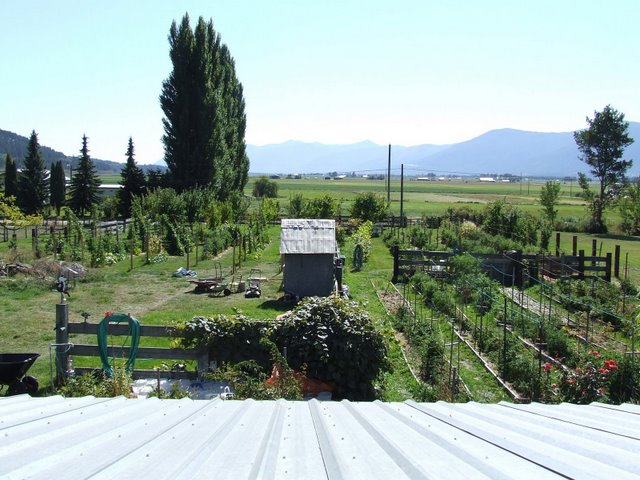
Between the two of us we had over a hundred years of experience gardening. (Now that makes me feel old.) We had gardened in climates that can be described as West Coast Marine, to Sub Arctic wilderness, to flat prairie and finally settled in what we commonly refer to as our little piece of paradise, here in the Creston valley, in south eastern B.C., Canada, located about 10 km. north of the Idaho panhandle and just below Kootenay Lake.
The property lies in a small microclimate that gives us a zone 5/6 Canadian version or 6/7 US version.
We were avid gardeners for years, and about 10 years ago noticed that more and more of the old varieties of vegetables were no longer being offered. Being raised in the generation that thought "if you aren't part of the solution, then you are part of the problem", we decided to start growing heirloom and open pollinated varieties of vegetables (especially tomatoes) and offering the seeds to other gardeners.
Well one thing lead to another and we ended up starting a private seed bank so that our and your grandchildren will be able to have the same tastes that you are having now. This past couple of years we had gone past tomatoes and started seed banking (cold and cool storage) any annual vegetable seed.
If you have questions or would like to contribute to this blog, please feel free to contact me at any time.

Also for those who wish to trade please contact me at the below e-mail address and I will get back to as soon as possible. Thank you.
Cheers,
Grunt
grungysgarden@gmail.com


I am sad to report that Dan McMurray passed away on February 15, 2012 at his home in Wynndel, British Columbia. Dan was 69 years old.

Much of the final years of Dan's journey is chronicled on this blog. He was a man who made a difference to many people, and his family believe that his thoughts in the last years and months of his life, and his work in preserving heritage seeds should remain available.

Disclaimer

What I post about ways, methods, and results is based on what I observe in my garden. Your growing conditions may achieve results that differ from mine. I am putting this blog here to offer a site to exchange gardening ideas and methods, and to exchange seeds.
I welcome questions and discussions about anything gardening. The only dumb questions are the ones you don't ask. I will try to find answers for questions that I can't answer, and may post links to sites that have clearer answers than I can come up with.

Seeds

I do have tomato seeds to offer. The seeds are free, but I ask you to help cover the postage and handling in one form or another.
They can be obtained through trading seeds, or paying for postage at the rate of $2.00 for the first ten varieties or seed packs, and an increase of $1.00 for every ten varieties or seed packs beyond that. Seed packs are approximately 25 seeds each (not counted, just a pinch of seeds). Germination rate usually exceeds that of commercial seed packs. If you have problems with germination, let me know, and I will replace the seeds, either with more of the same variety, or with a variety that I think will give you something similar to what the original variety would have. Please note. I am not a seed company. Iwill only offer seeds from my current trade lists and also if I have lots to spare from previous years. I don't check germination on older seeds, but my experience has been over 80% on five year old seed.

2010 FALL SEED LIST = http://tinyurl.com/4whnxy3 Some seeds from this list may be in limited supply, but I will do my best to fill your request.

Albums containing photos of most of the varieties I have, and other photos that may be of interest, can be found at:
http://www.picasaweb.google.com/tvgrunt, or
http://www.picasaweb.google.com/danvaltrial

When you have made up your list, send me a copy at grungysgarden@gmail.com

Changes ...

The status here has changed substantially, as you can see above. The blog will continue, hopefully with more frequent input than recently.
Seed saving and trading/sharing will also continue. I still want to bank seeds, not just of tomatoes, but I am older than the lead photo on the blog would indicate, and have passed the seed bank on to younger hands.
In the meantime, I will continue to pay it forward, and trade/share seed to all corners of the world, as I did with Val.
This poem, which we both have known since the 1960's gave us much comfort through Val's battle with cancer.

Desiderata

Go placidly amid the noise and haste,
and remember what peace there may be in silence.
As far as possible without surrender
be on good terms with all persons.
Speak your truth quietly and clearly;
and listen to others,
even the dull and the ignorant;
they too have their story.

Avoid loud and aggressive persons,
they are vexations to the spirit.
If you compare yourself with others,
you may become vain and bitter;
for always there will be greater and lesser persons than yourself.
Enjoy your achievements as well as your plans.

Keep interested in your own career, however humble;
it is a real possession in the changing fortunes of time.
Exercise caution in your business affairs;
for the world is full of trickery.
But let this not blind you to what virtue there is;
many persons strive for high ideals;
and everywhere life is full of heroism.

Be yourself.
Especially, do not feign affection.
Neither be cynical about love;
for in the face of all aridity and disenchantment
it is as perennial as the grass.

Take kindly the counsel of the years,
gracefully surrendering the things of youth.
Nurture strength of spirit to shield you in sudden misfortune.
But do not distress yourself with dark imaginings.
Many fears are born of fatigue and loneliness.
Beyond a wholesome discipline,
be gentle with yourself.

You are a child of the universe,
no less than the trees and the stars;
you have a right to be here.
And whether or not it is clear to you,
no doubt the universe is unfolding as it should.

Therefore be at peace with God,
whatever you conceive Him to be,
and whatever your labors and aspirations,
in the noisy confusion of life keep peace with your soul.

With all its sham, drudgery, and broken dreams,
it is still a beautiful world.
Be cheerful.
Strive to be happy.


Max Ehrmann, Desiderata, Copyright 1952.


Life comes with no guarantee of quality or quantity. It is up to you to remember to smell the flowers, watch the sunset, hear the birdsong in early morning, and the spring frogs in the evening. What ever happens in your little corner of it, it is still a beautiful world, and you do yourself a great disservice if you fail to see and celebrate what is there.
Grunt

A little footnote here, that will stay at the top of the blog. I have married again, for the fourth time. Another internet marriage, as Val's and mine was, and just as good, although completely different.
I was also diagnosed with lung cancer in May 2011, and started treatment to cure it in late August 2011.
The blog will carry on, in much the same vein as it always has. I will post mostly garden related articles, but also a few comments on things and life in general.
For a while, I thought Gump had it right = sh*t happens. He's wrong = LIFE happens


I am sad to report that Dan McMurray passed away on February 15, 2012 at his home in Wynndel, British Columbia. Dan was 69 years old. His family wishes his blog to remain for those who wish to read Dans' journey.
Tuesday, January 25, 2011

The Latest Seed List

I finally have a link to the 2010 FALL SEED LIST . The list has been up for about two weeks, but I forgot to add the link here. Please check through it, and ask for what tickles your fancy.
I will try to update and add to this blog on a more regular basis, and offer what I can for information about what strikes me as necessary through the season. If you have questions, or suggestions for topics to be covered, drop me a line, and I will see if I can offer any constructive input.
I hope you will all have a great 2011 gardening year.
Cheers
Dan

Tuesday, June 1, 2010

Another new spud bed

This is just to show you how quick and easy it can be to establish a new bed. In this case, it will be used this year to grow potatoes, although you could do the same thing without the potatoes, just to establish a bed for use next year, with a minimum of labour.

This is what I started with. I didn't even bother to mow the grass before starting.

Cardboard installed, first loads of mulch in place, and seed potatoes nested in the mulch. My "guard cat" is a paranoid wuss.

And here is the finished bed, just waiting for the potatoes to show up. Total time between the first photo and the last one is one hour, twenty five minutes, and that includes the time to mow the grass for the mulch.

When the potato plants start flowering, probably early August, I will add another heavy coat of mulch around the base of the plants, perhaps twice in a two week period. The plants tend to put out most of the tubers almost on the surface of the mulch then, and they will sunburn if they don't receive another blanket of mulch, just as they would if you didn't hill them. Come harvest time in the fall, I won't need a shovel, as the tubers will almost all be above the cardboard. And since they are totally surrounded with green mulch, there should be no scab on any of them. I will try to remember to post update photos of the progress of this new bed.


Next spring, the soil here should be much easier to dig, than it would be right now, and it will have a fairly high humus content due to the amount of broken down weed roots and mulch. Most of the cardboard will literally dissolve over the summer and winter. I will also expect a fairly high worm population when I do turn the soil.


Cheers

Dan

Sunday, May 30, 2010

I'm late again

It has taken me a bit longer to get back here to post than I had intended. I am slowly getting caught up with bed prepping, and lost some ground with my transplants.


I waited ten days after the latest frost date I've seen here, before I started planting out the beans and corn that I had prestarted. I guess I should have waited a few more days, because we had a very light frost four days later, and I lost over half of the beans I had planted out. The corn fared much better, with only 4 or 5 plants out of about 700 being affected at all by the frost. I also lost a good percentage of my squash plants in my hoop houses, as I had no heater going (there was no frost warning). Surprisingly, I only lost two melon plants. I would have thought they would be even more susceptible to frost than the squash, but apparently not.


Any varieties I lost that I have enough seed for to plant out now, and still have some left for another try next spring, I will try direct seeding, and hope to get enough to save seed from. The beans that I can't replant, I will direct seed some other variety as a replacement = I like to see the teepees filled out.


Now, how to "cheat" on making new garden beds.
I started by tearing the turf out along the border of the new bed section I wanted to create, and throwing the beaten out turf on top of the bed I was making. It looks like I have done more digging than is actually the case, as I beat the soil out of the roots, to help kill the weeds and break them down a bit quicker. I have actually only dug out about an 8" (20 cm) border around the bed.

Then I covered the bed with a couple of layers of cardboard. If you don't have cardboard, newspaper will do, but you will have to put it on at least 5 pages thick, and heavier would be better. Don't use glossy colour magazine pages, as the inks and dyes often have heavy metals in them, and you don't want to incorporate them into your soil.

Since this bed is going to have a melon in it for this year, I only manured the hole the hill is going to be located in. Some of the soil that is on the cardboard will be pulled up around the base of the melon plant when I transplant it.

Then, to make it a little less ugly for the summer, and to help break down the turf under the cardboard, I buried the cardboard in mulch. This mulch happens to be recycled from the top of another bed. Make your mulch layer at least 3" (8 cm) thick, heavier than that if you have mulch to do it with. Almost anything organic will do for this, as you can scrape it away later, if you don't want to add it to your soil.


The way I have done this is a bit more labour intensive than it has to be, but that is a matter of personal choice. The cardboard could have been laid directly on the sod, without digging the border, and just the hole for the melon dug out and manured, and the mulch added. I wanted the bed to already have an established border when I dig it out this fall or next spring.

There are other ways of creating new beds without having to fight the turf while it is still alive. Probably the best known of these, is "lasagna gardening" http://ourgardengang.tripod.com/lasagna_gardening.htm


I'll post a couple of photos next time, making a new bed without digging the border first. It is worth noting that you can do this on areas you don't intend to plant this year, and even leave it to be done until early in the fall if you don't have the time to spare now. Of course, the longer you have for the cardboard and mulch to kill and break down the turf, the easier it will be to turn the soil next spring.

Until next time, have fun in the dirt.

Cheers
Dan

Wednesday, April 28, 2010

Catching up

I'm not sure yet just how this years garden is going to do. I think I am going to be caught up with the bed preparations by the time things are supposed to be hitting the ground, but that could just be me being delusional.

I've cut way back on the tomatoes this year = Less than 40 varieties, with the total number of plants undecided yet, but probably 150 to 200, way down from the 500+ of the year before last.

As I did last year, I will be growing out 45 varieties of beans, only 8 of which are bush type, so there will be a whack of teepees in the garden again. They will be interspersed with 11 varieties of melons, 9 different winter squashes, 7 pea varieties, and 8 unique corns, most of which are flour or flint types, with first nation origins.


Something that many of you may not know, is that flint/flour corns can be eaten as a sweet corn, if you harvest while they are still in the milky stage, before the kernels change to their final colour. Some varieties are less flavorful then than sweet corns. Some rival the best sweet corns, with the bonus of having more than just sweet for taste.
Some of the corns I am trialing this year are sweet corns, and I am looking forward to seeing how well they do here, with our hot days and cool nights trying to lengthen their DTM.

I'll also have onions planted in their own bed, as well as stuck in here and there throughout the garden beds = the only interplanting that will occur this year. There should be a block of carrots, and another of beets, and a half dozen varieties of peppers, both hot and sweet (provided they germinate for me), a half dozen beds of potatoes that were planted late October last year, and enough tobacco plants to last me for the year (23 varieties).


Last years experiment with interplanting everything proved to me that it is possible to do without loss of production in anything. It also proved to me that it is only really doable if you have a smaller garden than I have, as the maintenance on the interplanting adds a bit more time and work.


If you don't keep on top of them, the pole beans will strangle the tomatoes, the squash will climb the pole beans, and the melons will hide under the tomatoes and pole beans, and try to climb the corn. Squash runners will need tucking back into the beds about every second day, or they will take over the pathways. I did learn how to keep the squash and melons from getting too aggressive, but I'll save that for another post, when I can take photos to illustrate.


I've been in the garden until dark every day the weather has let me play in the dirt. Still lots of weeds to get out of the beds before I can transplant, and still lots of manure to dig in for this years feed for the plants. Another 6 or 8 beds to turn from turf into garden, and I'll probably "cheat" a little on how I do that, but I'll leave the explanation for that process for the next post.


Cheers
Dan

Monday, February 8, 2010

Seed list is finally ready

We have had a more than eventful winter so far, but we finally have the seed list pulled together. There are offerings of beans, corn, peas, melons, squash, tobacco, and tomatoes, with links to the albums for each at the end of their respective listings. http://tinyurl.com/ygnh8v9
I'm afraid you will have to put up with me (Grunt) running the blog for now, as Grungy is busy battling cancer, and unable to post. I think we will be a bit more active here now, than we have been in the past couple of months.
for now, I will say, check out the seed list(s), and see what strikes your fancy. Make up your list of wants, and email us at grungysgarden@gmail.com and include your address. I will be starting to ship out seeds this week, but there are no guarantees as to how soon I will get your order out, although I will be as quick as I can.
Start doing now (if you can) any of the things needed to get your garden ready to go. If your soil isn't frozen solid, start chinking out weeds or digging in compost or manure. If it is frozen, and you can find your beds, start putting the compost and manure in place to be dug in when you can. It gets you outdoors and into the fresh air, and cuts down on what has to be done when everything needs to be done at once.
Wishing you all a great gardening year.
Dan

Saturday, November 21, 2009

Just a brief assurance that the blog has not been abandoned. We are experiencing an open fall, with weather that, most days, allows me to work in the garden. I am taking advantage of that, so the indoor work (computers, database, etc.) gets neglected. We had a mixed year for weather, with a few things doing exceptionally well, a few things doing atrociously, and most things just doing okay, but very late maturing.
Photos of "other than tomato" grow outs can be seen at http://www.picasaweb.google.com/danvaltrial
Some will have seed available later, some may not due to insufficient return. some of the peas and beans we only had 3 or 4 seeds to start with, and they will have to be regrown to increase, so may not be available. This years seed list will be posted here, when ready, but that may be a little while yet. As long as the weather lets me be outside, the indoor work is going to be deferred. Who knows, I may even get caught up out there.

Wednesday, May 6, 2009

"Just a little busy right now"

Just a little booster to let everyone know that the blog has not been abandoned, just set aside until we can catch our breathes again.
We have about 900 tomato seedlings in the hoop houses now, with 285 having already gone out the door to one of the local nurseries. We also have a few peppers and eggplants keeping the tomatoes company, 20 varieties of squash and 20 of melons that have just poked their heads up, and over half of the 55 bean varieties sitting in their paper pots, getting ready to germinate. 23 varieties of peas have already been prestarted and planted out. along with a handful of chard, lettuce and carrots.
The first batch of prestarted corn goes out tomorrow, or the next day that is good enough to get into the garden. Onions and a small patch of carrots have already been planted, and the onions are starting to emerge.
A few new beds have been dug, but there are still more than 200' of beds to be de-turfed and readied for planting, and another 600 drip emitters to be installed. The pathway drip system has to be assembled and installed, and another 1500 or so emitters fitted to those lines. All of the established beds, about 1100', have to be weeded and prepped for planting, and another 40 poles for bean teepees strung and erected.
The layout of this years garden has been committed to paper, and already altered on the ground. It should be interesting to see, as we are inter-planting everything throughout the rows, and trying a few vegetables that are new to us (collards and Couves Tronchuda, or Portuguese Cabbage) and a fairly fleshy leafed kale variety. Onions, beets, carrots, chard, and what ever else crosses our minds will get stuck in here and there throughout the garden rows, and maybe given a separate spot just for the heck of it. We might be pushing the envelope a bit with some of what we are trying, but it should all work, and will hopefully prove that you have room for more than you think, even in a fairly small garden.
There will be photos posted, as there are developments that warrant them, so stay tuned. First photos will likely come towards the end of May, if all goes anywhere near according to plan.
Have a great gardening year, and above all, enjoy it!!
Dan

Monday, March 16, 2009

Continuing the planting and germination

Today was the first day at planting tomatoes. These will become the early workhorses in the garden. With a little bit of luck we should be eating tomatoes by mid-July or earlier. The lettuce, collards, carrots are up and doing well. The hot peppers are continuing to poke their propeller heads through the soil. Now if we could just get more sunny days and a lot less clouds, everything would be hunky dory.

In about 10 days time the first batch of tomatoes will be transplanted into individual pots, and then as the first germination chamber empties, we will begin planting the main bulk of the tomato varieties.

Monday, March 2, 2009

Germination Success

Remember when I told you, we were doing some experiments with our germination chambers in the entry "A New Year Begins", well yesterday the lettuce poked up. Today it was followed by collards and one single chard. The germination chamber has been sitting out on our deck, with only 2 - 100 watt bulbs in the bottom and an old blanket over night over the top. The night time temperatures have been getting down to minus 6C, but we are getting about 20C rise inside the chamber.
Am I happy and excited or what!!!

Plant Labels

Have you ever wished for a cheap sturdy plant label? Look no farther than you closest window. Okay maybe not your window, but if you have a source of old Venetian window blinds, you have an very good source of labels. First remove the strings that allowed you to raise and lower the blind slats. Once you have removed them and have the slats themselves free, you can cut them into lengths of whatever size you wish. We cut most of our every 6". Grunt stacks them up about an inch high and runs them through the bandsaw. But they can be cut with scissors. Once you have the label the length you would like you can turn it into a hanging label by using a hole punch. (And yes a single paper punch will make a hole in them.) Run heavy cord, twine or twist tie material to form the hanger. You can use either a marking pen or pencil to write on the surface. If using a pencil, I would choose either a carpenter's pencil or a primary pencil as they have a wider lead. At the end of the season you can use an eraser for pencil writing or tape over the writing using either duct tape or masking tape. In fact if you go to your local thrift shop or dumpster dive, or are lucky enough to live near one of the hardwares that custom make the blinds to width, you should find a cheap enough source that you would not have to salvage the old ties.
Personally I figure that I should wear out the old stuff first.