About Grunt and Grungy ...
Between the two of us we had over a hundred years of experience gardening. (Now that makes me feel old.) We had gardened in climates that can be described as West Coast Marine, to Sub Arctic wilderness, to flat prairie and finally settled in what we commonly refer to as our little piece of paradise, here in the Creston valley, in south eastern B.C., Canada, located about 10 km. north of the Idaho panhandle and just below Kootenay Lake.
The property lies in a small microclimate that gives us a zone 5/6 Canadian version or 6/7 US version.
We were avid gardeners for years, and about 10 years ago noticed that more and more of the old varieties of vegetables were no longer being offered. Being raised in the generation that thought "if you aren't part of the solution, then you are part of the problem", we decided to start growing heirloom and open pollinated varieties of vegetables (especially tomatoes) and offering the seeds to other gardeners.
Well one thing lead to another and we ended up starting a private seed bank so that our and your grandchildren will be able to have the same tastes that you are having now. This past couple of years we had gone past tomatoes and started seed banking (cold and cool storage) any annual vegetable seed.
If you have questions or would like to contribute to this blog, please feel free to contact me at any time.
Also for those who wish to trade please contact me at the below e-mail address and I will get back to as soon as possible. Thank you.
Cheers,
Grunt
grungysgarden@gmail.com
Disclaimer
What I post about ways, methods, and results is based on what I observe in my garden. Your growing conditions may achieve results that differ from mine. I am putting this blog here to offer a site to exchange gardening ideas and methods, and to exchange seeds.I welcome questions and discussions about anything gardening. The only dumb questions are the ones you don't ask. I will try to find answers for questions that I can't answer, and may post links to sites that have clearer answers than I can come up with.
Seeds
I do have tomato seeds to offer. The seeds are free, but I ask you to help cover the postage and handling in one form or another.They can be obtained through trading seeds, or paying for postage at the rate of $2.00 for the first ten varieties or seed packs, and an increase of $1.00 for every ten varieties or seed packs beyond that. Seed packs are approximately 25 seeds each (not counted, just a pinch of seeds). Germination rate usually exceeds that of commercial seed packs. If you have problems with germination, let me know, and I will replace the seeds, either with more of the same variety, or with a variety that I think will give you something similar to what the original variety would have. Please note. I am not a seed company. Iwill only offer seeds from my current trade lists and also if I have lots to spare from previous years. I don't check germination on older seeds, but my experience has been over 80% on five year old seed.
2010 FALL SEED LIST = http://tinyurl.com/4whnxy3 Some seeds from this list may be in limited supply, but I will do my best to fill your request.
Albums containing photos of most of the varieties I have, and other photos that may be of interest, can be found at:
http://www.picasaweb.google.com/tvgrunt, or
http://www.picasaweb.google.com/danvaltrial
When you have made up your list, send me a copy at grungysgarden@gmail.com
Changes ...
Seed saving and trading/sharing will also continue. I still want to bank seeds, not just of tomatoes, but I am older than the lead photo on the blog would indicate, and have passed the seed bank on to younger hands.
In the meantime, I will continue to pay it forward, and trade/share seed to all corners of the world, as I did with Val.
This poem, which we both have known since the 1960's gave us much comfort through Val's battle with cancer.
Desiderata
Go placidly amid the noise and haste,
and remember what peace there may be in silence.
As far as possible without surrender
be on good terms with all persons.
Speak your truth quietly and clearly;
and listen to others,
even the dull and the ignorant;
they too have their story.
Avoid loud and aggressive persons,
they are vexations to the spirit.
If you compare yourself with others,
you may become vain and bitter;
for always there will be greater and lesser persons than yourself.
Enjoy your achievements as well as your plans.
Keep interested in your own career, however humble;
it is a real possession in the changing fortunes of time.
Exercise caution in your business affairs;
for the world is full of trickery.
But let this not blind you to what virtue there is;
many persons strive for high ideals;
and everywhere life is full of heroism.
Be yourself.
Especially, do not feign affection.
Neither be cynical about love;
for in the face of all aridity and disenchantment
it is as perennial as the grass.
Take kindly the counsel of the years,
gracefully surrendering the things of youth.
Nurture strength of spirit to shield you in sudden misfortune.
But do not distress yourself with dark imaginings.
Many fears are born of fatigue and loneliness.
Beyond a wholesome discipline,
be gentle with yourself.
You are a child of the universe,
no less than the trees and the stars;
you have a right to be here.
And whether or not it is clear to you,
no doubt the universe is unfolding as it should.
Therefore be at peace with God,
whatever you conceive Him to be,
and whatever your labors and aspirations,
in the noisy confusion of life keep peace with your soul.
With all its sham, drudgery, and broken dreams,
it is still a beautiful world.
Be cheerful.
Strive to be happy.
Max Ehrmann, Desiderata, Copyright 1952.
Life comes with no guarantee of quality or quantity. It is up to you to remember to smell the flowers, watch the sunset, hear the birdsong in early morning, and the spring frogs in the evening. What ever happens in your little corner of it, it is still a beautiful world, and you do yourself a great disservice if you fail to see and celebrate what is there.
Grunt
Monday, March 16, 2009
Continuing the planting and germination
In about 10 days time the first batch of tomatoes will be transplanted into individual pots, and then as the first germination chamber empties, we will begin planting the main bulk of the tomato varieties.
Monday, March 2, 2009
Germination Success
Am I happy and excited or what!!!
Tuesday, February 24, 2009
A New Year Begins
The soil and the trays are ready and this afternoon, I will be planting hot peppers, eggplants, and Cape Gooseberries in one tray (to be transplanted later, once they are up and have their true leaves). In another in cut off milk jugs, I will plant some early lettuce and collards. (Craving greens about now as there is still about 16 inches of snow on the ground.) And in the third tray we are doing an experiment with some corn and beans to see how long we can hold them in tall paper pots before their root penetrate the sides and try and grow together into a solid mat that is difficult if not impossible to separate.
We want to give the corn and beans an early jump start plus in our soil there is small threadlike white worms, that if the soil temperature is not just right, will burrow into the seed and eat the embryo.
Since there will be a fourth tray in the germination chamber, we will have to decide what else we want to plant, either for doing experiments on, or getting an early start. I will let you know what we have decided tomorrow.
Is any one else out there getting itchy fingers to start planting something? Please let us know either here under comments or at grungysgarden@gmail.com. Would love to hear what you are growing and how it is doing. Happy Garden!
Thursday, November 20, 2008
How does our garden go - part 5
With the peaches done, the pears, both European and Asian, are harvested this month, along with the grapes and apples. The canning kitchen takes on a fruity air, with the prepping and canning of pears, pear and apple butters, and of course juices from all three types of fruit. Most years, Grunt has the fruit press and macerator (a home built machine that "chews" the whole fruits into fine pieces) set up around the Canadian Thanksgiving weekend. (Of course, this year with everything being late - we just finished juicing last weekend (Nov 20th).) I have sewed 4 heavy duty bags that fit inside the press and after the fruit has been reduced to a pulpy mass it is scooped into the bags, which are tied shut and dropped into the chamber. Pressure is applied and the wonderfully sweet juice runs out into the collecting plate on the bottom and into waiting pails. Dozens and dozens of prepped jars are waiting in the kitchen, and as each pail is filled it is brought in, the juice is poured into the jars, lidded and processed through a pressure canner. Our neighbour, Alex, who helps Grunt outside at the press takes his juice home and his wife Ruby, pours their juice into washed and rinsed 2 litre plastic milk jugs. They freeze theirs, and when they want "fresh" juice, they merely remove the frozen container into the fridge the day before, allowing it to thaw, and then shake the container. I would do it too, but deep freeze space is limited in our household due to our seed banking passion for storing heirloom and open pollinated seeds. Once the pulp yeilds up it's juice, it is either fed to the chickens or goes into the compost pile. (I think the worms wait all year for juicing time. Go out a week or two later and they have all moved over to where the pulp has started to decay.)
The vegetable garden, has not been neglected. The soil continues to be weeded, the mulch fluffed and turned, and finally the fall amendments added and scratched in. Early in the month the bean poles are lowered and the beans pods are picked and sorted by the degree of of ripeness. Fully ripe pods are set aside for dried beans (some go to our seed bank, some are traded, most are stored and cooked later on). The not quite ripe beans are shelled as soon as possible in the evenings and processed as "shellys" which are canned and used as side dishes during the coming year. The empty vines are removed from their string supports and taken to the bulging compost bin. Can you guess what our evening activities are for a couple of weeks?
One is always amazed how naked the garden appears by Halloween. It is hard to believe how lush everything looked, only 3 months before, when the growth was at it's fullest.
Leaf raking and hauling also occurs in October and into November. As soon as the trees drop about half their leaves, I dig out my trusty leaf rake and start making leaf windrows. Grunt brings up a tarp and rakes them onto it, when it is so full that no more leaves can stay on it, he drags it down to the area where he will be sitting up the shredder/mulcher (near the corn stalks and the "L" of the compost bins). He makes a huge pile of leaves that he covers with a tarp to keep off the rain (or snow). When the last leaf is raked up and transported to the holding area, and the day is nice, the shredder is fired up and all the cornstalks and leaves are reduced to tiny pieces about 1/4 to 1/2 of an inch in size, and blown into a pile in the corner, which is covered with a weatherproof tarp. This combination of leaves, corn stalks and hay (when we can get it), will be used for the first mulch on the gardens, come spring planting time.
November - No more growing gardens outside, by mid month, no more soil turning, no more harvesting, no more long days outside (besides it is getting dark early). No more running out to the gardens to harvest fresh vegetables or flowers for the tables. No more hot days or weeks of sunny weather. Seems like November has a lot of "no s". However there are other enjoyable gardening "chores" to do. Now is the time to bag up individual packets of seeds, post trading lists on the forums. purchase bubble envelopes and stamps and let the trading begin in earnest. We must be nearing Christmas. Just about everyday there are envelopes stuffed with packets of seeds, either coming in or going out or both. One quickly learns what the postage is to and from several countries. Incoming seeds, must be catalogued, and filed. Seed bank donations are prepared and put to storage. I often wonder what the mail delivery people think of what is going on. The lady at the post office becomes one of you "bestest" friends. When you walk through the door, a bag of envelope in hands, she just smiles, reaches for the custom declaration stickers and opens the stamp drawer. She knows what you are there for and is quick to help you with the weighing and paper work.
December is a planning month. Next year's varieties lists are drawn up, and gone over. Garden space is alotted for each type of vegetable. Last year's records are gone over, checking for production and problems, and plans are drawn up of what is in line for next years garden. Seed catalogues are checked, both the paper and internet type. Ideas are exchanged by e-mail or snail mail. One has a chance to do some in depth reading of the previous year's posts and collect oodles of new ideas.
This is also the month that "Santa" tucks some of his goodies under each "good" gardener's tree. Maybe it's a subscription to a garden magazine, a new book, or if you have been really, really good, some new gardening gadget.
So now that I have shown you our garden over the year, we wish each and everyone of you a very Merry Christmas and a Great Gardening Season each and every year. Hopefully you will write us and tell us your stories or offer suggestions and or tips.
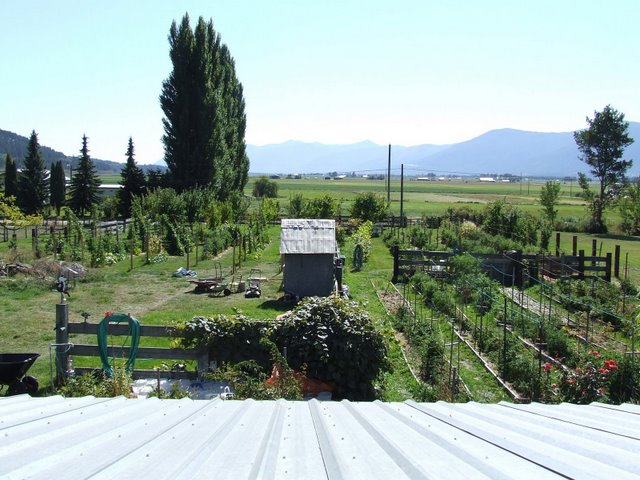
Sunday, November 16, 2008
How does our garden go - Part Three
We're busy, busy, busy, as most gardeners are. There is the seemingly endless cycle of weeding, watering, mulching and training the various types of plants to grow where we want them to be. Thank goodness our 12 year old niece, loves to run the mower and cut the grass. I am sure glad she had decided to spend the summer holidays with us, as it is a tremendous help having a 3rd body to take up the slack.
Providing we have a decent start to the spring, by the end of July the tomatoes are reaching towards the sky, loaded with blossoms and setting fruit like crazy. If we are lucky and have select early varieties, by mid-July, we are occasionally snacking on fresh heirloom tomatoes, with their various combinations of flavors and textures. Ummmm! Chopped up with fresh lettuce, and green onions, a little vinegar and olive oil dressing makes a wonderful change to the diet.
Towards the end of July, while Grunt struggles mightily to keep up to the rampant growth in the garden, my interest diverges somewhat toward the orchard and the commencement of canning. Around the 20th of the month the sweet cherries are ready to go, followed quickly by the early apricots.
August seems to be filled with days that do not have enough hours. The garden still needs it's care and attention, and by mid month is when we start to harvest the tomatoes in bulk. When they come through the door, the seeders are set aside for a few hours while the rest of the tomatoes are processed either as whole, stewed, chunked, or salsa. While these are going through the pressure canner, I slice the seeders in half, squeeze out the seeds in to baggies to ferment (thanks to Dave (American Gardener) for the tip) and then put the rest into a large pot to cook slowly in the oven in preparation for juicing or saucing. It hardly seems like I get one batch done, and Grunt is bringing in some more tasty heirloom/open pollinated tomatoes to do. When the tomato section of the garden gets ahead of my processing, there is a line up of people who are willing to drop in and take extras of my hands. They love the old fashioned vine ripened taste.
And if that isn't enough, the late apricots and early to mid season peaches and early pears, crowd into the processing line up. I try to save an hour or so each day to at least look at the garden and do some of the minor weeding, or mulching chores.
Although we are busy, this is one of my favorite times of the year. Every day brings something new and wonderful outdoors. It is the height of insect activity and the first batch of nestlings are now learning to fly. It seems like you can actually sit (if you had the time) and watch everything grow.
By mid to late August, the first of the melons are ready to harvest, and our diet goes from the usual meat, potatoes and two veggies, to one very high in fruit and vegetables. The heirloom melons and early summer squash are also yielding up their seeds for the seed bank, although they must dry throughly and won't be banked for another month or so. And with a warm summer, the first ears of sweet corn add that wonderful taste and aroma to the kitchen.
Towards the end of the month our "helper", has to return to school, so we cut down watering the lawn, so that it will not need as frequent mowings. This tolerable to us, because by now, the garden beds usually have a nice thick mulch coat that can be as deep as 4 inches.
Near the end if the month it seems like everything wants to be sampled, and picked, and preserved towards the coming winter. No wonder our grandmothers were so busy with all their heirloom vegetables, and they looked forward to the coming fall and winter.
Coming soon - Part 4 September and October........
Friday, November 14, 2008
How does our garden go - Part One
January -
is a preparation month. It starts off by cleaning and sterilizing the starting trays. Then comes the mixing of the potting mix. We use a mixture of peat moss, vermiculite and perlite, and supplements such as epsom salts, fine bonemeal, superphosphate, and miracle grow. Stir well, add a small amount of snow or rain water to moisten the mix and make it damp. The trays are then filled and stacked awaiting planting. We are also busy filling seed requests and preparing seeds for the seed bank.
February -
continues seed trading, seed bank preparation, and around Valentine's day, Grunt sets up the first germination chambers and starts the lights which provides bottom heat, and warmth to the seeds and seedlings. By the 20th of the month, eggplants, peppers and Cape Gooseberries have found their way into their nice warm dirt beds to begin sprouting. The germination chambers are set up outside where the plants will receive only natural sunlight for growth. By the end of the month, we are done seed banking and the test tubes of precious seeds are in their boxes and having a deep cold sleep in the deepfreeze.
March - begins the real push into planting. By the end of March (usually starting around the 15th - 20th) all of our planned tomatoes are planted and germinating in the chambers. With the snow usually gone, Grunt is getting active in the actual garden, doing the spring preparation work, or making new beds. Meanwhile I am preparing the new trays for beans, corn, ect. to be planted and helping outside in the gardens or doing early pruning and trimmings. During his rather busy days, Grunt will set up our hoop greenhouses, and put out the heaters to start warming them up.
April - Now is the time for transplanting our little sprouts into their "grow bigger" transplant pots and transferring them a tray at a time over to the hoop houses. As the germination chambers empty of peppers, tomatoes, ect., near the the 2oth of the month, corn is planted out into deep paper pots, to get a jump on our cool spring weather. By the end of April, tiny spears of corn are popping through and they move into the line up in the hoop houses to make way for deep paper pots of bean seeds. By the end of April seed exchanging has slowed down and now when we have a spare moment we can start cataloguing our new aquistions.
More about May to August next time .......