Who we are.

For those of you who don't know about us, a little history to fill you in.

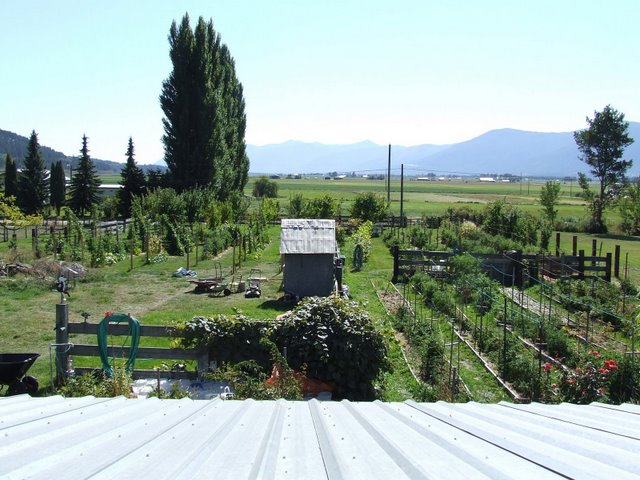
Between the two of us we have over a hundred years of experience gardening. (Now that makes me feel old.) We have gardened in climates that can be described as West Coast Marine, to Sub Arctic wilderness, to flat prairie and finally settled in what we commonly refer to as our little piece of paradise, here in the Creston valley, in south eastern B.C., Canada. We are located about 10 km. north of the Idaho panhandle and just below Kootenay Lake.
Our property lies in a small microclimate that gives us a zone 5/6 Canadian version or 6/7 US version.
We have been avid gardeners for years, and about 10 years ago noticed that more and more of the old varieties of vegetables were no longer being offered. Being raised in the generation that thought "if you aren't part of the solution, then you are part of the problem", we decide to start growing heirloom and open pollinated varieties of vegetables (especially tomatoes) and offering the seeds to other gardeners.
Well one thing lead to another and we ended up starting a private seed bank so that our and your grandchildren will be able to have the same tastes that you are having now. This past couple of years we have gone past tomatoes and now seed bank (cold and cool storage) any annual vegetable seed. (In fact should you be willing to donate to the said seed bank, please contact me at - grungysgarden@gmail.com and we can discuss your donation.
In fact if you have questions or would like to contribute to this blog, please feel free to contact me at an time.

Also for those who wish to trade please contact us at the below e-mail address and I will get back to as soon as possible. Thank you.
Cheers,
Grunt and Grungy
grungysgarden@gmail.com

Disclaimer

What we post about ways, methods, and results is based on what we observe in our garden. Your growing conditions may achieve results that differ from ours. We are putting this blog here to offer a site to exchange gardening ideas and methods, and to exchange seeds.
We welcome questions and discussions about anything gardening. The only dumb questions are the ones you don't ask. We will try to find answers for questions that we can't answer, and may post links to sites that have clearer answers than we can come up with.

Seeds

We do have tomato seeds to offer. The seeds are free, but we ask you to help cover the postage and handling in one form or another.
They can be obtained through trading seeds, or paying for postage at the rate of $2.00 for the first ten varieties or seed packs, and an increase of $1.00 for every ten varieties or seed packs beyond that. Seed packs are approximately 25 seeds each (not counted, just a pinch of seeds). Germination rate usually exceeds that of commercial seed packs. If you have problems with germination, let us know, and we will replace the seeds, either with more of the same variety, or with a variety that we think will give you something similar to what the original variety would have. Please note. We are not a seed company. We will only offer seeds from our current trade lists and also so if we have lots to spare from previous years. We don't check germination on older seeds, but our experience has been over 80% on five year old seed.

Seeds harvested in 2007= http://tinyurl.com/3a4smu

Seeds harvested in 2008= http://tinyurl.com/66p5aj

Albums containing photos of most of the varieties we have, and other photos that may be of interest, can be found at:
http://www.picasaweb.google.com/tvgrunt

When you have made up your list, send us a copy at grungysgarden@gmail.com

Saturday, November 21, 2009

Just a brief assurance that the blog has not been abandoned. We are experiencing an open fall, with weather that, most days, allows me to work in the garden. I am taking advantage of that, so the indoor work (computers, database, etc.) gets neglected. We had a mixed year for weather, with a few things doing exceptionally well, a few things doing atrociously, and most things just doing okay, but very late maturing.
Photos of "other than tomato" grow outs can be seen at http://www.picasaweb.google.com/danvaltrial
Some will have seed available later, some may not due to insufficient return. some of the peas and beans we only had 3 or 4 seeds to start with, and they will have to be regrown to increase, so may not be available. This years seed list will be posted here, when ready, but that may be a little while yet. As long as the weather lets me be outside, the indoor work is going to be deferred. Who knows, I may even get caught up out there.

Wednesday, May 6, 2009

"Just a little busy right now"

Just a little booster to let everyone know that the blog has not been abandoned, just set aside until we can catch our breathes again.
We have about 900 tomato seedlings in the hoop houses now, with 285 having already gone out the door to one of the local nurseries. We also have a few peppers and eggplants keeping the tomatoes company, 20 varieties of squash and 20 of melons that have just poked their heads up, and over half of the 55 bean varieties sitting in their paper pots, getting ready to germinate. 23 varieties of peas have already been prestarted and planted out. along with a handful of chard, lettuce and carrots.
The first batch of prestarted corn goes out tomorrow, or the next day that is good enough to get into the garden. Onions and a small patch of carrots have already been planted, and the onions are starting to emerge.
A few new beds have been dug, but there are still more than 200' of beds to be de-turfed and readied for planting, and another 600 drip emitters to be installed. The pathway drip system has to be assembled and installed, and another 1500 or so emitters fitted to those lines. All of the established beds, about 1100', have to be weeded and prepped for planting, and another 40 poles for bean teepees strung and erected.
The layout of this years garden has been committed to paper, and already altered on the ground. It should be interesting to see, as we are inter-planting everything throughout the rows, and trying a few vegetables that are new to us (collards and Couves Tronchuda, or Portuguese Cabbage) and a fairly fleshy leafed kale variety. Onions, beets, carrots, chard, and what ever else crosses our minds will get stuck in here and there throughout the garden rows, and maybe given a separate spot just for the heck of it. We might be pushing the envelope a bit with some of what we are trying, but it should all work, and will hopefully prove that you have room for more than you think, even in a fairly small garden.
There will be photos posted, as there are developments that warrant them, so stay tuned. First photos will likely come towards the end of May, if all goes anywhere near according to plan.
Have a great gardening year, and above all, enjoy it!!
Dan

Monday, March 16, 2009

Continuing the planting and germination

Today was the first day at planting tomatoes. These will become the early workhorses in the garden. With a little bit of luck we should be eating tomatoes by mid-July or earlier. The lettuce, collards, carrots are up and doing well. The hot peppers are continuing to poke their propeller heads through the soil. Now if we could just get more sunny days and a lot less clouds, everything would be hunky dory.

In about 10 days time the first batch of tomatoes will be transplanted into individual pots, and then as the first germination chamber empties, we will begin planting the main bulk of the tomato varieties.

Monday, March 2, 2009

Germination Success

Remember when I told you, we were doing some experiments with our germination chambers in the entry "A New Year Begins", well yesterday the lettuce poked up. Today it was followed by collards and one single chard. The germination chamber has been sitting out on our deck, with only 2 - 100 watt bulbs in the bottom and an old blanket over night over the top. The night time temperatures have been getting down to minus 6C, but we are getting about 20C rise inside the chamber.
Am I happy and excited or what!!!

Plant Labels

Have you ever wished for a cheap sturdy plant label? Look no farther than you closest window. Okay maybe not your window, but if you have a source of old Venetian window blinds, you have an very good source of labels. First remove the strings that allowed you to raise and lower the blind slats. Once you have removed them and have the slats themselves free, you can cut them into lengths of whatever size you wish. We cut most of our every 6". Grunt stacks them up about an inch high and runs them through the bandsaw. But they can be cut with scissors. Once you have the label the length you would like you can turn it into a hanging label by using a hole punch. (And yes a single paper punch will make a hole in them.) Run heavy cord, twine or twist tie material to form the hanger. You can use either a marking pen or pencil to write on the surface. If using a pencil, I would choose either a carpenter's pencil or a primary pencil as they have a wider lead. At the end of the season you can use an eraser for pencil writing or tape over the writing using either duct tape or masking tape. In fact if you go to your local thrift shop or dumpster dive, or are lucky enough to live near one of the hardwares that custom make the blinds to width, you should find a cheap enough source that you would not have to salvage the old ties.
Personally I figure that I should wear out the old stuff first.

Tuesday, February 24, 2009

A New Year Begins

A new year begins in Grunt and Grungy's garden.
The soil and the trays are ready and this afternoon, I will be planting hot peppers, eggplants, and Cape Gooseberries in one tray (to be transplanted later, once they are up and have their true leaves). In another in cut off milk jugs, I will plant some early lettuce and collards. (Craving greens about now as there is still about 16 inches of snow on the ground.) And in the third tray we are doing an experiment with some corn and beans to see how long we can hold them in tall paper pots before their root penetrate the sides and try and grow together into a solid mat that is difficult if not impossible to separate.

We want to give the corn and beans an early jump start plus in our soil there is small threadlike white worms, that if the soil temperature is not just right, will burrow into the seed and eat the embryo.

Since there will be a fourth tray in the germination chamber, we will have to decide what else we want to plant, either for doing experiments on, or getting an early start. I will let you know what we have decided tomorrow.
Is any one else out there getting itchy fingers to start planting something? Please let us know either here under comments or at grungysgarden@gmail.com. Would love to hear what you are growing and how it is doing. Happy Garden!

Friday, February 20, 2009

Another way of Saving Brassica seeds

Todays method is brought you by Frank Van Keirsbilck who is Orflo on Homegrown Goodness.
Thank you Frank.

Growing seeds from all sorts of brassicas, especially cabbages is something that seems to be frightening lots of people. But, this is really not necessary, if you stick to some rules, it's in fact easy to grow out seeds (if you can spare the place , of course).

Most brassicas are biennal, so this means they need two years to form seeds, there are however some noticeable exceptions: broccolis or even early cauliflowers,, rocket or aragula and a few others grow seed in one year time, some others are even triennal or perennial.

The first thing to do is to find out what variety you have (this is mostly easy, as it's written on the seed packet), and what species this variety belongs to.

The most common grown species are brassica juncea(mustard and others), brassica napus (rutabaga, rapeand others), brassica oleracea (broccoli, cauliflower, Brussels sprouts, cabbages, kales, collards, kohlrabi), brassica rapa (turnip, browwoli raap, chinese cabbage,..), crambe maritima (sea kale), eruca sativa (rocket or aragula), raphanus sativus (radish)). These species will never cross with each other, but will cross with other varieties within the species. Thus, a broccoli will not cross with a chinese cabbage or a rutabaga, for instance, but it will cross with Brussels sprouts or collards!

So it's perfectly possible to grow out one variety of each species in order to save seeds from these.

Another thing that's really important is that brassicas are outbreeders, meaning, if you have only one lonely cauliflower that's flowering, it won't set any seeds (again, there are some lesser-grown exceptions). Two plants work, but are just a very small genetic base for seed production, so grow out at least 10 plants of each variety, more is better (10 is really an absolute minimum)

So, how to start? Just start sowing seeds from the brassicas as you would do normally, plant them out and watch them grow. Whenever winter arrives (I'm talking about the most common biennal brassicas here), make a selection: take the best plants only (and keep them apart) for seed production, and eat the smaller or different shaped ones. This is important, it's a way to select better and better plants (and seeds) for the future. Have a good look at the plants, for instance:is the variety you want seeds from originally round, and are there some flatter-shaped ones in it? Select the round ones, then, unless you want to create a 'new' flatter variety (then you should select the flat-shaped ones, off course). Depending on the climate you have, and on the cold-resistance of the brassica varieties, take them to a conservation room, or leave them in the garden. Don't eat anything from the selected plants, this is better. Take a second look after the winter: did they survive easily, did they get many rotten leaves or sicknesses,... Take, again, the good-looking healthy ones and keep these, plant them out in spring if you had to place these inside. And make sure this is the only variety within the species you will re-grow... or isolate them, as described further.

Most brassicas flower very easily , one noticeable exception is cauliflower, which needs to be cut with a knife in the middle of the plants, in a sort of X-shape. After flowering and, of course pollination by insects, seeds start to form, first on the low side of the plants, and slowly this formation will creep up to the top . Build a sturdy support around the plants, the stems loaded with seeds can fall over and you could lose a lot. It takes quite a long time for seeds to start really ripening off, I never noted it exactly, but it 's at least two months in my climate. Whenever the pods start changing colour, from green to mostly brown , and start to look a bit brittle, it's time for some action. Depending on the varieties and species, pods can suddenly burst open and shatter some seeds, so when you feel they are completely dry, take them and put them in some sort of bag. Be careful , at this ripening stage, birds can cause a lot of damage, so, if necessary, cover the plants with some sort of netting. Another cause of damage are all sorts of aphids, these can easily be taken off.

It's best to leave the pods to ripen completely on the plants, brassica seeds usually don't develop further when the stems have been cut away from the plants .

The seeds, if kept and a dry and dark room, can be used for a long time, some 4-5 years, so you can build in a sort of yearly seed-growing rotation if you want to keep on sowing different varieties from your own seeds.

Off course, there are also methods for growing out two or even three brassica varieties of the same species in one year: build some isolation cages over the brassicas, each variety gets one isolation cage, let's suppose you want to grow out three brassica oleracea varietes: red cabbage, a kale variety and Brussels sprouts. So, when you have placed the cages over the selected varieties (before flowering, off course), open up on day one the cage of the red cabbage, and keep the other two closed, on day two open up the kale cage, and keept the other ones closed, and so on... This will reduce the amount of seeds somewhat, but brassicas are mostly very prolific seed producers, a harvest of one pound of seeds from 10 plants isn't exceptional, although this depends a bit on the variety.

Another method for growing out two or more seed-brassicas is having a minimum distance between the varieties. There's lots of discussion about this one, some yell out it has to be 2 miles, at least, others speak of less than half a mile. I'm pretty sure all these persons are right... So, where do all these differences come from? First of all, insect varieties, some have a wider range than others, European honey bees for example go as far as 5 miles to pollinate (this is just an indication, because these bees aren't the main pollinators for brassicas), other hover flies or mason bees or... fly only a few hundred yards away from their homes. So, that's the first difficulty, second is a sort of physical barrier: if two brassica varieties are separated from each other with a large field of wild flowers, a big hedge, a house, ... they could perfectly well produce 'true ' seeds , even if they are only 100 foot from each other! You have to search and experiment a bit...every place has its own specific circumstances, what works in one place, could fail in another...


Some brassica varieties (I'm thinking especially about mustards and Chinese cabbages here, but there are some others) have a tendency to bolt too early, without having formed a true crop. Don't use these for seed-saving, you will only select on this early-bolting characteristic, and that's really not a good thing to do, again, follow the rule: take the best varieties....

If you want to go a bit further, you could try and start creating your own brassica variety. This is infact also easily done, but it takes time. I'll illustrate this with an example:

two brassica oleracea varieties: you have a red cabbage and a savoy cabbage, and you want to create a red cabbage with the familiar curly leaves of the savoy cabbage... grow out a line of each of these two varieties, right next to each other , and select only one plant (the best looking and healthiest, off course) from each of these two varieties. So now you have two plants that are quite close to each other, so they surely will cross-pollinate. That's the first step, the second step is sowing out the produced seeds the next year, and select again on the plants you have grown out, do this for some years, and you might end up with the curly red cabbage...But this could take some patience....

Wednesday, February 18, 2009

This how to save seed from brassicas, brought to you by Tim Peters on Homegrown Goodness.

Brassica's fall into 2 major groups for seedsavers,
annuals and biennials. these 2 groups each need a different approach to seedsaving.

Annual brassica
these are those that if sown January (midwinter) onwards until late spring may go to seed. Many mustards, ch. cabbages, many broccoli, early cauliflower, oriental turnips, are in this class.

Biennials (or functionally biennial)
These are cabbages, brussel sprouts, kolhrabi, most cauliflower esp. the later ones, rutabaga, most turnips from Europe... etc. These for the most part need to be planted early enough so that when the cool and shortest days of fall start to lengthen again the flowering mechanisms are triggered. There is a fine line sometimes between being big enough and to big ...esp. if you are leaving them to the rigors of the outdoors

Since brassica are a dry seed, it is best if they mature in dry weather. From the flower bud to dry seed is anywhere from 40-60 days. Frost can kill the developing embryo in most varieties so this needs to be a frostfree time (mustards excepted). Keep this in mind and plant early enough to accomplish a warm weather flowering and a dry weather maturing. this means getting to know your varieties, and your climate. If you can not get a dry weather maturity, harvest when the pods yellow and let dry down inside... they can be hung from rafters, etc.
When the pods are dry the seed can be extracted by vigorously moving the stalks in a beating motion from side to side in a 35 gallon plastic garbage can. The material dumped onto sifting screens, and finally fan winnowed in a wheelbarrow (see my wheat threshing/seedcleaning techniques). ...Air speed on the fan will be lower than used for wheat, ...you drop the seed/trash mix and move your drop to where the seed is going into the barrow, and the trash is going over the lip onto the tarp spread under the barrow (if you have a mishap you can pick up trash and seed and re-clean). For large quantity of threshing proceed as for my wheat threshing techniques.
feel free to contact me at any time at atimberline@yahoo.com
Tim Peters


Tuesday, February 17, 2009

Planting Time - Or starting your transplants


Now is the time we start thinking of starting the seeds of our vegetables and fruit that will need transplanting. So today I will be covering our germination chamber. It was made from some 1/4" plywood, bubble wrap, staples, wood screws and a small amount of lumber,(a couple of 1"x2" or a 1"x4" ripped in half, and a 1"x8" cut into 1 inch strips (or any 1" thick lumber that can be cut into material for slats)). Plus a few electrical pieces we will discuss later. You can see the construction details at http://picasaweb.google.ca/TVgrunt/2008SEEDSTARTING
Click on the photos for a larger photo.
Remember that these particular starting chambers were designed to accommodate the materials on hand, the size of the trays we were going to use, and the space that they had to fit into. You can use any dimensions that work for you, but plan them out before you start cutting the materials
First we built an open topped box out of the plywood and 4 pieces of the lumber cut to 1" x 1" x 18" long. Cut the sheet of plywood into 2' x4' pieces and then cut one of these pieces in half to make 2 - 2'x2' (end pieces.) The other 3 are the bottom and 2 sides. The lumber pieces are attached vertically to the end plywood piece with wood screws making sure that the bottoms of the end pieces and the plywood is flush. Attach the sides to the ends, by using wood screws to hold the long plywood pieces to the end pieces, again making sure that the bottoms of the 1"x1" and the plywood are flush. Measure the distance between the upright 1x1"s (on the ends it should be somewhere between 20" and 21" and on the sides the distance should be somewhere between 44" and 45"). You will need to cut 4 more pieces of 1"x1" for each of the lengths that you have measured. Insert one piece the right length between each of the upright 1"x1", flush with the bottom of you open rectangle. Screw these piece to the plywood. When joining I would suggest a screw every 6 inches a long the length.

Turn your open rectangle upside down, and attach the 3rd sheet of plywood to all 4 pieces of 1"x1" supports. This will give you an open box that is 2'x4'x2'high. Turn the box over so the open top is up. Now take the extra 1"x1" that you cut and attach them flush with the tops of the upright 1"x1". Done correctly you will have a lip that is about 4" from the top of your box. This will become the support for your slatted inserts.

Making the inserts. Measure the internal dimensions of your box. Set 4 strips aside for rails. Cut the rest of your 1" strips crosswise, to the length of the width of the interior of your box - 1/2" (this will allow you to lift the inserts out easily) . Take four pieces that you have set aside for rails and cut them to a length that is 1/2 the length of your inside measurement of your box minus 1/2" (again for ease of removal) and lay them parallel to each other, at a distance that the rest will reach across and end up flush with the outside edges of the rails. Attach each slat with a screw at each end. You will leave a slat's width between each slat to allow the heat to rise up into the upper chamber. Make sure that you embed the screws tightly. I would use 1 1/4" wood screws here.

Tomorrow, we will continue making our germination chamber.

Sunday, February 15, 2009

Seed Starting Tips #6 - Or when to start your transplants

One should start the vegetables that have a longer or warmer soil requirement ahead of time, but the question keeps coming up - when do I plant them. Below is just a general rule of thumb, based on your last spring frost date.

Tomatoes - 6 to 8 weeks
Cabbages - 10 to 12 weeks (make sure you have a deep enough pot for the roots)
Onions - 6 to 10 weeks
Eggplants 10 to 12 weeks
Peppers 10 to 12 weeks
Corn 2 to 3 weeks (again a deep pot - at least 6 inches)
Beans 1 to 3 weeks (again a deep pot - at least 6 inches)
Squash 2-3 weeks ( use a paper pot so the roots are not disturb while transplanting)
Melons 2-3 weeks ( again use a paper pot to prevent disturbing the roots)